
Study Uncovers Hypertension‑Osteoarthritis Link via AVP‑AVPR1A Axis
Cloud-Clone Copeptin ELISA kits deliver critical quantitative evidence supporting the landmark neuroendocrine crosstalk
Press Release Disclaimer: This is a press release distributed through the XPR Media network. It has not been independently verified by our newsroom.

Cloud-Clone Copeptin ELISA kits deliver critical quantitative evidence supporting the landmark neuroendocrine crosstalk discovery
HUSTON, TX, UNITED STATES, October 26, 2026 /EINPresswire.com/ — Osteoarthritis (OA) ranks among the most prevalent chronic joint disorders worldwide, long interpreted mainly as an outcome of mechanical joint wear. Growing epidemiological observations have identified hypertension as an independent risk factor that nearly doubles the likelihood of radiological OA. Until now, the molecular link connecting elevated systemic blood pressure to local cartilage deterioration remained poorly defined. A newly-published landmark Science research article uncovers the AVP-AVPR1A neuroendocrine signaling axis as the key molecular bridge between hypertension and accelerated OA progression. Validated across human population cohorts, hypertensive animal models and multi-omics assays, this work provides fresh translational insights for degenerative joint disease research. Reliable biomarker measurements powered by Cloud-Clone copeptin ELISA kits formed an essential segment of the study’s experimental evidence.
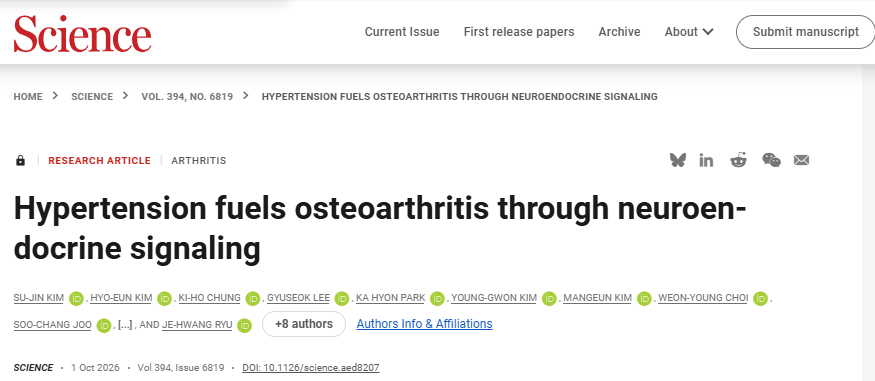
Figure 1: Webpage screenshot of the original Science research article titled Hypertension fuels osteoarthritis through neuroendocrine signaling.
Hypertension as an overlooked accelerator of osteoarthritis
Affecting an estimated 595 million individuals globally in 2020, osteoarthritis represents a leading source of elderly-population disability. Characterized by irreversible progressive cartilage degradation, subchondral bone remodeling, synovial irritation and persistent pain, OA can ultimately require joint-replacement surgery. No existing therapeutic agents can halt or reverse disease advancement; current clinical interventions focus predominantly on symptomatic pain relief.
Historical understanding framed OA purely as age-related mechanical degeneration. Modern clinical evidence positions OA as a complex multifactorial condition strongly tied to metabolic disturbances. Among metabolic-syndrome components, hypertension stands out as a consistent, independent risk factor. Data from the Framingham and Rotterdam cohorts demonstrate higher OA incidence among hypertensive participants even after adjusting for age, body-mass index and physical activity. Meta-analysis outputs show hypertensive individuals carry approximately two-fold higher risk for radiological OA and 1.5-fold elevated risk for symptomatic OA. Still, how hypertensive signals propagate from the circulatory system into joint tissue had remained unresolved before this Science report.
Uncovering the AVP-AVPR1A neuroendocrine molecular bridge
Figure 2: Schematic illustration summarizing the two-hit AVP-AVPR1A pathogenic mechanism, integrating human cohort analysis, hypertensive mouse-model validation and downstream cartilage-destruction molecular events.
Combining large-scale human cohort analysis, two distinct hypertensive mouse models, transcriptomic profiling, genetic ablation and pharmacological modulation, the research team defined a “two-hit” pathogenic framework linking hypertension and OA. Six major innovations underpin this breakthrough:
1.Specific receptor identification: Transcriptomic screening singled out Avpr1a as the sole significantly up-regulated AVP receptor gene within OA-affected chondrocytes, marking AVPR1A as the tissue-specific molecular gateway responding to systemic hypertensive signals.
2.Two-hit pathogenic model: Isolated hypertension or isolated AVP elevation cannot trigger OA independently. The first hit originates locally: mechanical injury or biological aging elevates AVPR1A expression on chondrocytes and primes joint cartilage. The second hit arises systemically: hypertension raises circulating AVP concentrations, which then activate AVPR1A on primed chondrocytes. Cartilage destruction occurs only when both conditions coincide, establishing hypertension as an accelerator rather than an initiator of OA.
3.Novel endocrine-skeletal crosstalk pathway: Circulatory AVP originating outside joint tissue enters the synovial compartment, binds AVPR1A on disease-primed chondrocytes, boosts catabolic activities and suppresses matrix-synthetic programs, driving cartilage matrix breakdown. This systemic-hormone-to-skeletal-degeneration signaling cascade had not been systematically characterized previously.
4.Elimination of confounding pathways: Losartan targeting the RAAS pathway and a selective oxytocin-receptor antagonist failed to mitigate cartilage damage, proving the pathological mechanism operates independently of those well-studied signaling routes.
5.Dual genetic-pharmacological target validation: Both Avpr1a knockout mice and intra-articular delivery of relcovaptan, a selective AVPR1A antagonist, substantially reduced hypertension-driven cartilage erosion and subchondral bone thickening, validating AVPR1A as a druggable therapeutic target.
6.Downstream effector confirmation: Nuclear receptor NR4A3 was verified as the core downstream transcription mediator. NR4A3 knockdown reversed AVP-triggered catabolic phenotypes, whereas NR4A3 overexpression promoted matrix degradation and repressed anabolic gene expression, offering a further refined intervention candidate.
Multi-layered evidence from human cohorts through molecular assays
Human population evidence: Analysis of the KNHANES national cohort covering 36 820 participants aged 45 years and older confirmed independent correlation between hypertension and OA prevalence. Correlation strength peaked within the 65-74-year-old subgroup. Imaging-subset data (n = 13 717) showed that hypertension correlates with greater OA severity defined by Kellgren-Lawrence grading, reinforcing its role in accelerating disease progression.
Animal-model validation: Two hypertensive mouse strains (DOCA-salt induced and genetic BPH/2J) receiving DMM surgical OA induction exhibited aggravated cartilage erosion and subchondral-bone thickening, without altered synovitis or osteophyte maturation, demonstrating selective impacts on the cartilage-subchondral-bone unit.
Tissue-level observation: Multi-omics and immunohistochemistry confirmed elevated AVPR1A expression within diseased human and mouse chondrocytes, while AVPR1A remained minimally expressed within healthy young cartilage. Expression rose progressively with aging or post-surgical joint damage.
Circulatory origin of AVP: AVP-encoding mRNA could not be detected within chondrocytes or synovial fibroblasts, proving joint tissue does not synthesize AVP locally. Detectable copeptin, a stable surrogate biomarker for AVP, was measured in OA patient synovial fluid and serum samples collected from DOCA-salt hypertensive mice, confirming systemic AVP travels into joint cavities.
Intervention outcomes: Genetic deletion or pharmacological inhibition of AVPR1A alleviated cartilage breakdown under hypertensive conditions. Mechanistic assays demonstrated that AVP-AVPR1A signaling upregulates matrix-degrading proteases MMP3 / MMP13 and suppresses cartilage-synthetic markers including Sox9, Col2a1 and Acan. This pathological shift proceeded without triggering cellular senescence, differing from earlier proposed models for hypertension-related joint degeneration.
Figure 3: Multi-omics and functional experimental datasets showing transcriptomic shifts, altered catabolic-anabolic gene profiles and downstream NR4A3-driven molecular events triggered by AVP-AVPR1A pathway activation.
Critical assay support from Cloud-Clone Copeptin ELISA kits
Arginine vasopressin (AVP) exhibits very short half-life in circulating blood and poses substantial direct-measurement challenges. Copeptin, a stable C-terminal fragment derived from the AVP prohormone, is released at equimolar quantities with AVP and serves as a reliable readout reflecting endogenous AVP secretion.
Within this high-impact Science investigation, Cloud-Clone ELISA kits generated indispensable quantitative datasets bridging animal-model observations and human clinical biospecimens:
Mouse serum copeptin was quantified using Cloud-Clone CEA365Mu ELISA reagent, documenting elevated circulating copeptin under hypertensive conditions and validating the systemic “second-hit” hypothesis.
Human synovial-fluid copeptin from OA patients was measured with corresponding Cloud-Clone human copeptin ELISA kits (assay range:12.35–1000 pg/mL). All clinical sample readings fell within the linear standard-curve interval, experimentally proving system-derived AVP reaches intra-joint compartments.
These two sets of biomarker results anchored the core mechanistic hypothesis. Cloud-Clone kits were selected for broad-species coverage, dependable linear detection for low-abundance analytes, and consistent lot-to-lot performance that satisfies reproducibility standards expected for high-impact scientific publications.
Research significance and translational outlook
This published work fills a long-standing mechanistic gap by delineating the AVP-AVPR1A neuroendocrine axis that links hypertension and degenerative joint disease. The two-hit conceptual framework logically explains why hypertension exacerbates degeneration predominantly in already-injured or aged joints. Spanning cardiovascular, endocrine and skeletal research domains, the complete evidence chain integrates human epidemiology, in-vivo animal interventions and molecular functional testing.
Therapeutically, AVPR1A antagonists such as relcovaptan represent promising candidate disease-modifying agents for hypertensive-patient OA management. Practical clinical translation still requires further investigation, including improved antagonist safety profiles, expanded female-subject datasets, and deeper exploration of crosstalk between AVP-AVPR1A and additional cartilage-metabolism regulatory networks. Even so, this study opens new directions for treating comorbid hypertension and osteoarthritis across global aging populations.
Comorbid hypertension and osteoarthritis impose heavy public-health burdens worldwide. This Science finding illuminates a previously under-recognized neuroendocrine crosstalk route connecting cardiovascular risk factors to joint deterioration. Rigorous biomarker detection forms the backbone of such translational discoveries. Cloud-Clone high-performance ELISA biomarker platforms support researchers exploring endocrine, skeletal, cardiovascular and inflammatory disease mechanisms, delivering reproducible quantitative measurements for pre-clinical and clinical specimen workflows.
Reference: Su-Jin Kim et al. Hypertension fuels osteoarthritis through neuroendocrine signaling. Science 394, eaed8207 (2026). DOI:10.1126/science.aed8207
SuKi Duan
CLOUD-CLONE CORP.WUHAN
email us here
Visit us on social media:
LinkedIn
Instagram
TikTok
X
Legal Disclaimer:
EIN Presswire provides this news content “as is” without warranty of any kind. We do not accept any responsibility or liability
for the accuracy, content, images, videos, licenses, completeness, legality, or reliability of the information contained in this
article. If you have any complaints or copyright issues related to this article, kindly contact the author above.

Media gallery


